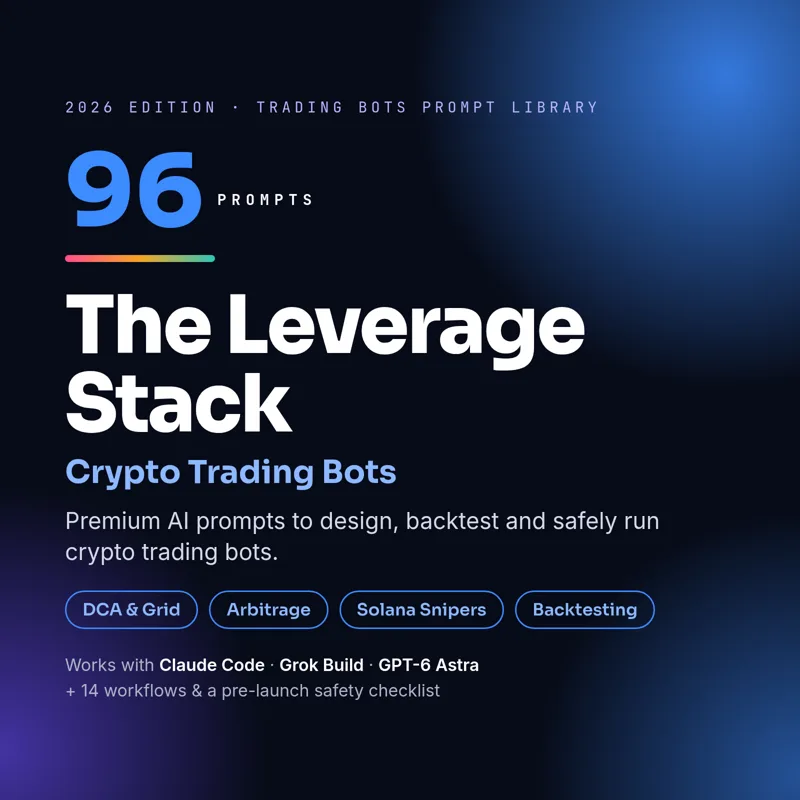
Crypto trading bot prompts for engineers who put risk first
Prompts and build briefs for designing, coding and testing crypto trading bots with agentic coding tools, built around paper trading, hard risk limits, kill switches and honest cost modelling.
Instant digital download · PDF + Notion · pay with USDT, BTC, ETH, SOL or LTC
Most trading-bot tutorials start with a strategy and bolt on safety at the end. This edition does the reverse. Before any strategy code, you write a precise spec, define risk limits and a kill switch, harden your API keys and build a paper-trading engine. Every build prompt tells the coding agent to default to paper mode and never to place live orders unless you explicitly enable it.
From there the edition covers DCA, grid, trend-following, mean-reversion, arbitrage monitoring, funding-rate monitoring, market-making simulation, signal alerts and Telegram or webhook control panels, each with stress tests and post-mortem prompts. It is an engineering and education resource: backtests and paper results do not predict live results.
Here are five real prompts from the edition, exactly as written in the PDF and Notion files.
Five sample prompts
Bot Strategy Spec Writer (TB-001)
Best tool: Claude or GPT-6 Astra for structured specs.
ROLE: You are a quantitative developer who writes precise, testable specifications for trading bots.
CONTEXT: Bot idea: [BOT_IDEA]. Market: [TRADING_PAIR] on [EXCHANGE]. Timeframe: [TIMEFRAME]. Why I think it could work: [THESIS].
TASK: Turn the idea into a one-page spec: exact entry rules, exit rules, position sizing, order types, data needed, risk limits, conditions that pause the bot, and what "the strategy has stopped working" looks like.
OUTPUT FORMAT: Markdown spec with those headings, a list of ambiguous rules I must clarify, and a "Version 1 scope" list of what to leave out.
RULES: Education and engineering practice only, not financial advice. Never promise or estimate profits. Default to paper trading or testnet, assume API keys have withdrawals disabled, and include position limits and a kill switch.
Risk Limits & Kill-Switch Designer (TB-002)
Best tool: Claude or GPT-6 Astra.
ROLE: You are a risk manager for automated trading systems.
CONTEXT: Bot type: [BOT_TYPE]. Paper capital I will test with: [PAPER_CAPITAL]. Markets: [TRADING_PAIRS].
TASK: Design a risk policy: maximum position size, maximum daily and weekly loss, maximum open orders, maximum order rate, price-sanity checks (reject orders far from the last price), stale-data checks, and a kill switch with every trigger that should fire it.
OUTPUT FORMAT: Limits table (Limit | Value | Why | What happens on breach), kill-switch triggers list, and a test case for each limit.
RULES: Education and engineering practice only, not financial advice. Never promise or estimate profits. Default to paper trading or testnet, assume API keys have withdrawals disabled, and include position limits and a kill switch.
API Key & Secrets Hardening Plan (TB-003)
Best tool: Any model.
ROLE: You are a security engineer who protects exchange accounts used by bots.
CONTEXT: Exchanges I use: [EXCHANGES]. Where the bot runs: [HOSTING] (for example: my laptop, a VPS). Repository: [REPO_DESCRIPTION].
TASK: Write a hardening plan: trade-only keys with withdrawals disabled, IP allowlists where supported, separate sub-accounts per bot, secret storage, key rotation, 2FA on the exchange account, and what to do if a key leaks.
OUTPUT FORMAT: Checklist grouped by Exchange, Server, Code and Incident response, with a one-line reason for each item.
RULES: Education and engineering practice only, not financial advice. Never promise or estimate profits. Default to paper trading or testnet, assume API keys have withdrawals disabled, and include position limits and a kill switch.
Fee, Slippage & Latency Reality Check (TB-007)
Best tool: GPT-6 Astra for careful arithmetic.
ROLE: You are a skeptical execution analyst.
CONTEXT: Strategy: [STRATEGY_SUMMARY]. Average trades per day: [TRADES_PER_DAY]. Expected edge per trade before costs: [EDGE_ESTIMATE]. Fees: [FEE_RATE]. Typical spread: [SPREAD].
TASK: Estimate the total cost per trade (fees, spread, slippage, funding if relevant) and show how much edge is left. Show the break-even edge and how sensitive the result is to each cost.
OUTPUT FORMAT: Cost table, a sensitivity table, and a plain-English verdict on whether the idea survives costs on paper.
RULES: Education and engineering practice only, not financial advice. Never promise or estimate profits. Default to paper trading or testnet, assume API keys have withdrawals disabled, and include position limits and a kill switch.
Build: Paper-Trading Engine (TB-005)
Best tool: Claude Code or Grok Build.
ROLE: You are a trading-systems engineer.
GOAL: Build a paper-trading engine that simulates fills against live market data so strategies can run without real money.
REQUIREMENTS:
- Language: [PROGRAMMING_LANGUAGE]. Live data from [EXCHANGE] public endpoints only (no API key needed).
- Simulate market and limit orders, fees of [FEE_RATE], slippage based on order-book depth, and partial fills. Track balances, positions and realized and unrealized P&L.
- Same interface as the live connector, so switching modes is a config change.
- Store every simulated order and fill in SQLite and export to CSV.
PROCESS: Plan first and wait for approval. Write tests for fill logic, fees and P&L math. Run them before reporting.
OUTPUT: How to run a strategy in paper mode, the fill assumptions used, and where the simulation is optimistic compared with real trading.
No promise is made or implied. The prompts teach software engineering and risk management. Backtests and paper trading do not predict live results, and nothing here is financial advice.
Which coding tools do the build prompts target?
Claude Code, Grok Build and Codex. Builds use common open-source libraries such as ccxt and default to paper-trading mode.
Does it cover API key security?
Yes. There is a dedicated secrets-hardening prompt (no withdrawal permissions, IP allow-lists, key rotation) and authorization reviews for Telegram and webhook controls.
What do I get?
The prompts and step-by-step workflows in a designed PDF plus a Notion-ready Markdown file, for a one-time $20.
Not financial advice. Education only. Not financial advice. Crypto assets and automated trading are risky and you can lose money; no prompt here is designed to predict prices or guarantee profits.
 The Leverage Stack