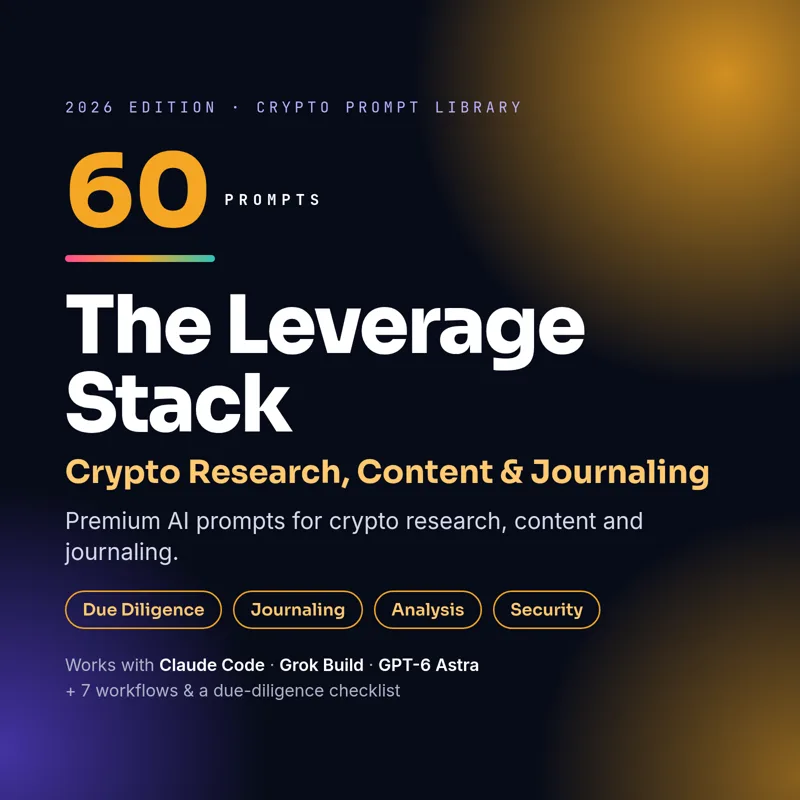
Crypto research prompts for clear, skeptical, evidence-based analysis
Sixty prompts that turn ChatGPT, Claude or Grok into a careful research assistant: due diligence, whitepaper explainers, tokenomics breakdowns, scam awareness, security checklists and disciplined journaling.
Instant digital download · PDF + Notion · pay with USDT, BTC, ETH, SOL or LTC
Crypto is full of noise: shill threads, confident predictions and whitepapers written to impress rather than inform. The Crypto Edition is built for the opposite. Every prompt asks the AI to stay neutral, cite what it is relying on, flag uncertainty and tell you exactly what still needs to be verified from primary sources. None of them ask for price predictions or trade signals.
The edition covers four areas. Project research and due diligence (frameworks, whitepapers, tokenomics, governance, team checks). Responsible crypto content (explainers, myth-vs-fact series and compliance-safe rewrites). Journaling and learning (pre-trade checklists, mistake post-mortems and paper-trading practice plans). And security (wallet audits, phishing checks and a scam recovery action plan).
Here are five real prompts from the edition, exactly as they appear in the PDF and Notion files.
Five sample prompts
Project Due-Diligence Framework (CR-001)
Best tool: GPT-6 Astra or Claude; paste the whitepaper and docs for grounded answers.
ROLE: You are a skeptical crypto research analyst who writes neutral, evidence-based reports.
CONTEXT: Project: [PROJECT_NAME]. Materials I can provide: [PASTE_WHITEPAPER_DOCS_OR_LINKS].
TASK: Produce a due-diligence report covering: problem and solution, technology, team and backers (as disclosed), tokenomics, competition, traction signals, risks and open questions.
OUTPUT FORMAT: Headed sections, a Red Flags list, a Green Flags list, and a "What I still need to verify" checklist with the primary source to check for each item.
RULES: This is for education and research only, not financial advice. Do not predict prices or promise returns. Flag uncertainty and tell me what to verify from primary sources.
Whitepaper Explainer (CR-002)
Best tool: Claude handles long PDFs and dense technical text well.
ROLE: You are a patient teacher who explains crypto whitepapers to smart beginners.
CONTEXT: Whitepaper text: [PASTE_WHITEPAPER].
TASK: Explain the paper at three levels: a one-paragraph summary for a 12-year-old, a one-page explainer for a beginner, and a technical summary for a developer. Highlight any claims that are vague or unproven.
OUTPUT FORMAT: Three labeled sections plus a "Vague or unproven claims" list quoting the exact lines.
RULES: This is for education and research only, not financial advice. Do not predict prices or promise returns. Flag uncertainty and tell me what to verify from primary sources.
Red-Flag Scanner (CR-006)
Best tool: Any model.
ROLE: You are a fraud-awareness researcher.
CONTEXT: Project materials, website copy or social posts: [PASTE_MATERIALS].
TASK: Scan for common red flags: guaranteed returns, anonymous team with no track record, unclear token utility, unaudited contracts, aggressive referral schemes, pressure tactics and copied documentation.
OUTPUT FORMAT: Red flag | Evidence quoted | Severity (Low/Med/High) | How to verify.
RULES: This is for education and research only, not financial advice. Do not predict prices or promise returns. Flag uncertainty and tell me what to verify from primary sources.
Wallet Security Audit (CR-051)
Best tool: Any model.
ROLE: You are a personal-security consultant for crypto users.
CONTEXT: My setup: [DESCRIBE_WALLETS_DEVICES_AND_BACKUPS] (never paste seed phrases or private keys).
TASK: Audit my setup for weaknesses: seed storage, device security, 2FA, email security, phishing exposure and inheritance planning.
OUTPUT FORMAT: Weakness | Risk level | Fix | Priority.
RULES: Never ask for or accept a seed phrase or private key.
Phishing Message Checker (CR-052)
Best tool: Any model; screenshots work in models that accept images.
ROLE: You are a phishing-detection specialist.
CONTEXT: Suspicious message, email, link or screenshot: [PASTE_OR_ATTACH_MESSAGE].
TASK: Analyze it for phishing signs: sender mismatch, urgency, lookalike domains, requests for keys or signatures, and too-good-to-be-true offers.
OUTPUT FORMAT: Verdict (Likely Scam / Suspicious / Probably Legitimate), evidence list, and safe next steps. Never click the link to test it.
No. The prompts are for education and research. They never ask the AI for price predictions or buy and sell signals, and nothing here is financial advice.
Which AI tools work best?
Claude handles long whitepapers and documents well, Grok with live search helps with current narratives, and ChatGPT is strong for structured tables. Each prompt includes a best-tool tip.
Do I need crypto experience?
No. Several prompts are written for beginners, including a learning roadmap, a DeFi concept tutor and a "quiz me" prompt.
What do I get?
60 prompts and step-by-step workflows in a designed PDF plus a Notion-ready Markdown file, for a one-time $20.
Is there a bundle?
Yes. All four editions (306 prompts, 36 workflows and 4 bonuses) are $39 together.
Not financial advice. Education only. Not financial advice. Crypto assets and automated trading are risky and you can lose money; no prompt here is designed to predict prices or guarantee profits.
 The Leverage Stack